

First published June 2026. Figures are as at that date and will change.
Ask most new serviced-accommodation investors where the money is, and they point to the postcard locations, the Northumberland coast, the castle towns, the seafront. The nightly rates there are the highest in the region, so surely the returns must follow. They almost never do, and understanding why is the single most useful thing a North East investor can learn.
The confusion comes from mixing up two very different numbers: revenue and return. A property's nightly rate and occupancy decide its revenue. But the return, the figure that actually determines whether the investment is any good, is that revenue, net of running costs, measured against the capital you had to put in to get it. And in the North East, the places with the highest nightly rates are also the places with the highest entry prices. The rate goes up, but the price you pay goes up faster.
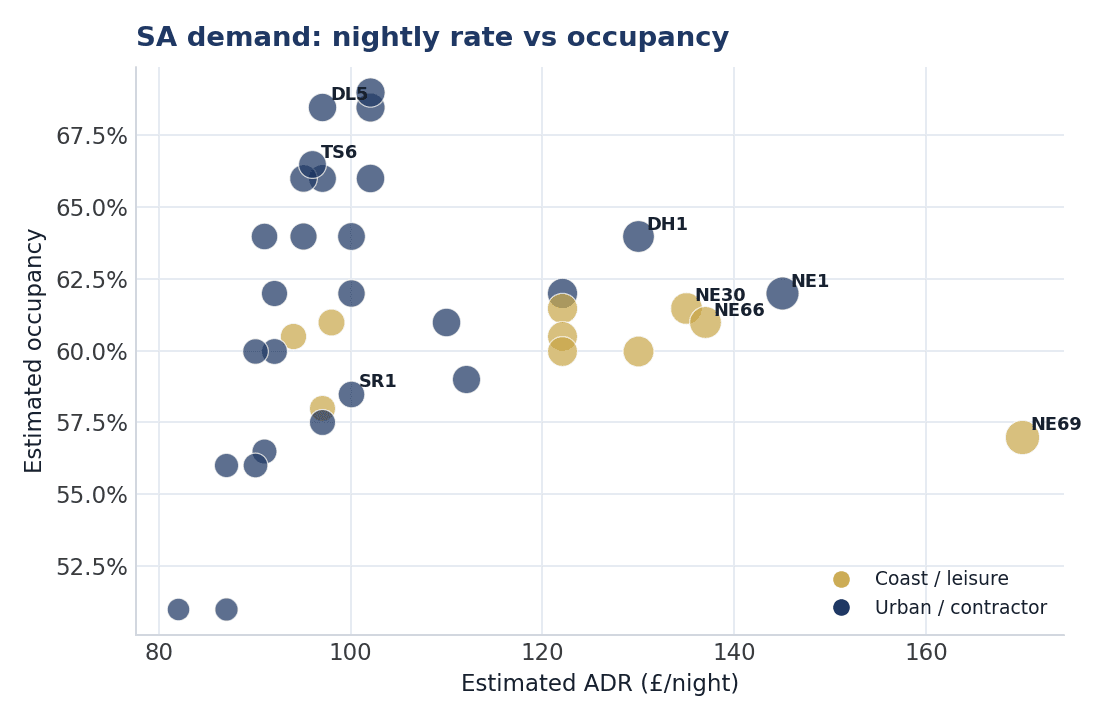
North East serviced-accommodation demand: estimated nightly rate against occupancy, with bubble size showing annual revenue. Coastal and leisure areas (gold) earn high rates but seasonally; urban and contractor areas (navy) earn steadier, year-round occupancy. Estimates to be validated before purchase.
The numbers that actually matter
Across Newcastle, the typical short-stay property is booked for around 208 nights a year and generates roughly £21,000 in annual revenue, with median occupancy near 57%. The best-run properties in strong locations push well past that, top-quartile operators reach 67% and above. Those are healthy figures, and they are exactly why serviced accommodation has become such an attractive strategy in the region.
- 57%: Newcastle SA median occupancy, about 208 nights a year (Airbtics, 2024–25)
- ~£21k: Average annual SA revenue, typical Newcastle property (Airbtics, 2024–25)
- +15.8%: Newcastle rent growth in a year, highest of any major English city (ONS, Feb 2026)
But notice what those figures describe: a city property, in an area with steady year-round demand, bought at a North East price. The return works because the revenue is solid and the entry cost is modest. Change either side of that equation and the picture changes completely.
The coast looks tempting. The maths says otherwise.
Take a premium coastal property. It might command a headline nightly rate of £150 to £170, far above a city unit. But three things quietly erode the return. The entry price is often two to three times higher, so the same revenue is spread over far more capital. Demand is seasonal, so the high rate only applies for part of the year and occupancy sags in winter. And the running costs of a short-let business, cleaning, management, utilities, voids and platform fees, typically swallow a little over half of revenue regardless of location.
Put those together and a property with the highest nightly rate in the region can deliver one of the lowest yields in it. The rate is real. The return is not.
A high nightly rate tells you what a property earns on a good night. It tells you almost nothing about what you will earn on your money.
Where the real returns are hiding
The strongest serviced-accommodation returns in the North East tend to sit in places that few tourists would put on a postcard, because they are driven by something more reliable than scenery: a genuine, year-round demand engine paired with an affordable entry price. The pattern repeats across the region.
- Business-park and corporate hubs, areas around Cobalt and Quorum, or Doxford in Sunderland, fill midweek with relocating professionals and project teams, the demand that protects occupancy when leisure tails off.
- Contractor and industrial corridors, the Nissan supply chain, the Hitachi and Aycliffe corridor in County Durham, and Teesside's Teesworks and freeport generate sustained, multi-month stays at modest entry prices.
- Hospital catchments, the corridors around Newcastle's major hospitals produce dependable medium-term demand from staff, visiting families and patients, often on cheaper stock with room to add value.
None of these areas wins on nightly rate. All of them win on the thing that matters, the return on the capital you actually deploy. That is the difference between buying a story and buying an investment.
One property, three ways to run it
The same house can be approached as a straightforward buy-to-let, as a serviced-accommodation operation, or, without buying at all, as a rent-to-serviced-accommodation arrangement, where you rent a property on a long let and operate it for short stays with the owner's consent. Each has a different risk and return profile: buy-to-let is the lowest-effort and most financeable; serviced accommodation can earn considerably more but is an operating business; rent-to-SA can produce the highest return on the small amount of capital it needs, but carries the most operational work and the sharpest regulatory exposure. The right answer depends entirely on your capital, your time and your appetite for risk, which is exactly why a generic "best strategy" recommendation is worth so little.
A word on the 2026 rules. Serviced accommodation is moving into a more regulated era, a national short-term-let registration scheme is expected, a new planning use class has been proposed, and the furnished-holiday-let tax advantages have already gone. None of this kills the strategy, but it does reward operators who plan around it rather than discover it after completion.
The discipline that protects your money
Here is the uncomfortable truth about every nightly-rate and occupancy figure you will read, including the ones in this article: they are benchmarks and estimates, not promises for a specific address. The only responsible way to commit capital is to validate the numbers for the exact property and street you are considering, checking real performance data in short-let data tools, testing the assumptions, and stress-testing the return against finance costs and a realistic void period.
That validation step is where most of the value, and most of the risk reduction, actually lives. It is also where honesty about incentives matters. When AyNik is paid for a service, such as our sourcing fee, we say so in writing before you rely on our work, and every figure we show is labelled with its source.